
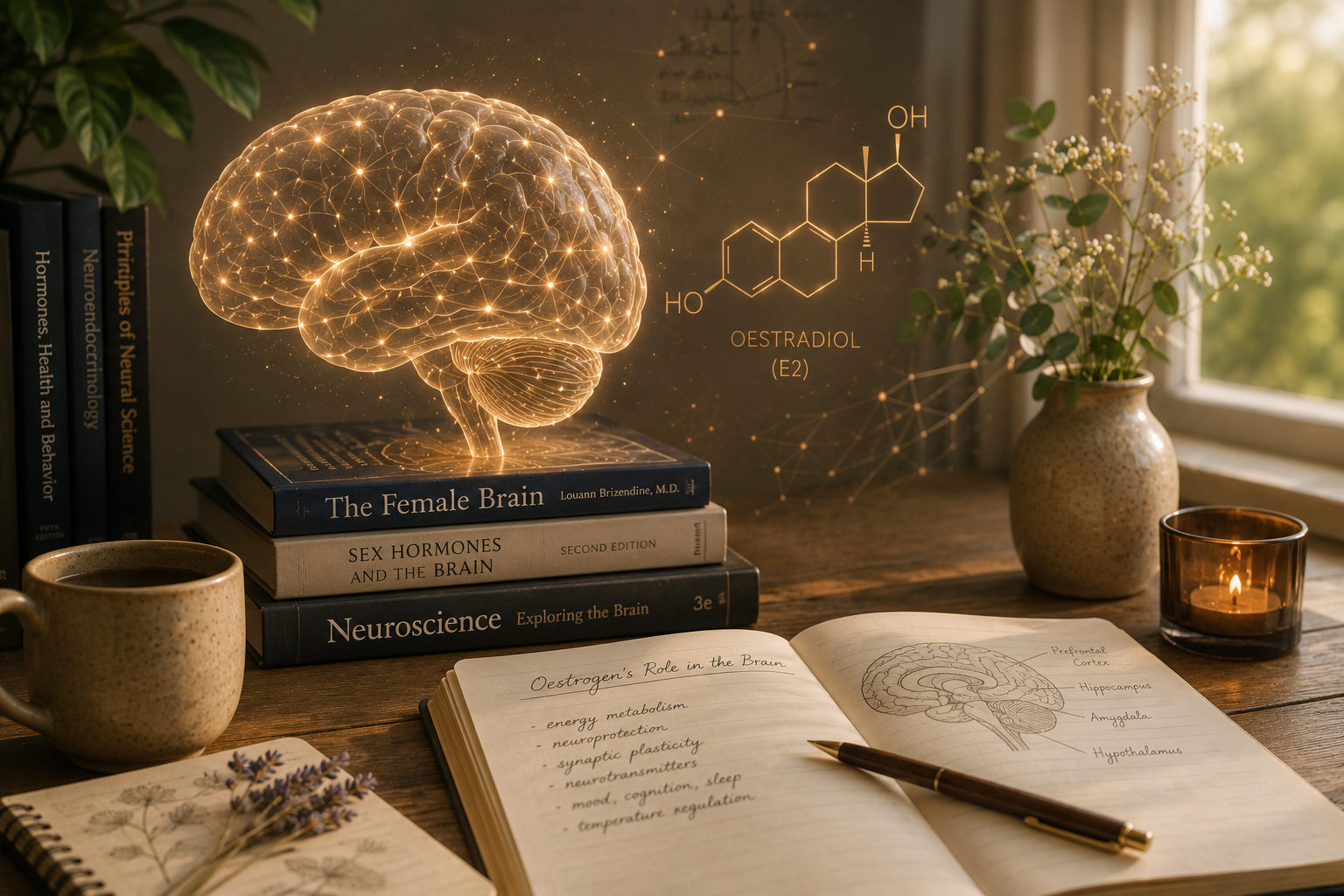
Oestrogen's Role in the Brain
The Hormone That Quietly Powers Your Mind
"I thought oestrogen was just a reproductive hormone."
Exactly what I thought.
If someone had asked me a few years ago what oestrogen did, I'd probably have said it regulated the menstrual cycle, helped maintain bone health and prepared the body for pregnancy.
All true.
But only part of the story.
One of the biggest changes in menopause research over the last twenty years has been the growing realisation that oestrogen isn't simply a hormone produced by the ovaries.
It is also one of the brain's most important chemical messengers.
In fact, some neuroscientists now describe menopause as a neurological transition as much as a reproductive one.
When I first read that, I stopped.
Could one hormone really influence memory, sleep, body temperature, mood, anxiety, concentration and even the way the brain produces energy?
The answer appears to be...
Yes.
The Discovery That Changed Everything
For many years scientists thought of oestrogen almost entirely in terms of reproduction.
The ovaries produced it. The uterus responded to it. Simple.
Then advances in neuroscience began revealing something unexpected.
Oestrogen receptors—the tiny docking stations that allow cells to respond to hormones—weren't just found in reproductive organs.
They were scattered throughout the brain.
Suddenly everything started looking rather different.
If brain cells are covered in oestrogen receptors, perhaps oestrogen has been influencing the brain all along. That idea has transformed how researchers think about menopause.
Your Brain Has Been Listening to Oestrogen Since Puberty
One of the fascinating things about the brain is that different areas specialise in different jobs.
The hippocampus is heavily involved in learning and memory.
The prefrontal cortex helps with concentration, planning and decision-making.
The amygdala plays an important role in processing emotions and recognising threats.
The hypothalamus regulates body temperature, sleep, appetite and hormones.
These are precisely the areas many women notice changing during perimenopause.
That's hardly a coincidence.
Each of these regions contains oestrogen receptors.
For decades, oestrogen has quietly been helping these areas do their jobs.
During perimenopause those hormonal signals begin to fluctuate, and the brain notices.
Oestrogen Doesn't Just Influence the Brain. It Helps Power It.
One discovery fascinated me more than any other.
Oestrogen doesn't simply send messages between brain cells.
It helps those cells produce energy.
Every nerve cell in your brain contains tiny structures called mitochondria.
They're often described as the power stations of the cell.
It's an excellent analogy.
Their job is to convert glucose into ATP, the molecule that provides almost every cell with usable energy.
Without ATP, nothing happens.
No thinking.
No remembering.
No learning.
No communication between nerve cells.
Producing ATP is incredibly demanding, especially inside the brain.
Although your brain accounts for only around 2% of your body weight, it consumes roughly 20% of your body's energy.
Every conversation. Every memory. Every decision. Every time you recognise someone's face or find the right word in a sentence...
You're spending energy.
Research over the last two decades has shown that oestrogen helps support this remarkable process.
It improves the brain's ability to use glucose and helps mitochondria produce ATP more efficiently.
In other words, oestrogen isn't simply involved in reproduction.
It's quietly supporting the brain's energy supply every day.
Suddenly, the findings from our previous article begin to make much more sense.
If menopause changes the way the brain uses energy, and oestrogen plays an important role in that energy production, it's easier to understand why researchers are so interested in the relationship between the two.
Exactly how this energy shift happens is still being investigated, but it is one of the most exciting areas of menopause neuroscience today.
Building Connections
Our brains don't work because individual nerve cells think independently.
They work because billions of cells communicate with one another through tiny junctions called synapses.
Think of synapses as conversation points.
One nerve cell releases chemical messengers. Another receives them. The message continues.
Learning something new, remembering a friend's phone number or following a conversation all depend on these connections working efficiently.
Researchers have discovered that oestrogen helps maintain these synapses and supports the remarkable flexibility of the brain, known as neuroplasticity—its ability to strengthen existing connections and form new ones throughout life.
The brain isn't a fixed organ. It's constantly adapting.
Oestrogen appears to play an important supporting role in that process.
The Chemistry of How We Feel
Oestrogen also influences many of the brain's chemical messengers.
You may have heard of serotonin, sometimes called the "feel-good" neurotransmitter.
Then there's dopamine, involved in motivation, reward and focus.
Noradrenaline helps regulate alertness and attention.
GABA helps calm electrical activity within the brain and plays an important role in relaxation and sleep.
Oestrogen interacts with all of them.
That's one reason the menopause transition can sometimes affect mood, motivation, anxiety and sleep in ways that seem completely unrelated.
It's not because women suddenly become less resilient.
The chemistry inside the brain is genuinely changing.
Protecting Healthy Brain Cells
Another idea that has changed scientific thinking comes from neuroscientist Professor Roberta Brinton.
Her research suggests that oestrogen's role isn't simply to repair damage.
Instead, it appears to help healthy brain cells remain healthy by supporting their energy production, communication and resilience.
Researchers sometimes refer to this as the Healthy Cell Bias theory.
It's one of the reasons scientists are so interested in understanding how the timing of hormonal changes may influence long-term brain health.
There's still much to learn, but it's another reminder that oestrogen's role extends far beyond reproduction.
We're Still Learning
One of the things I enjoy most about reading research is that good studies often create more questions than answers.
Scientists now know that oestrogen influences brain energy, communication between nerve cells, neurotransmitters and many of the regions responsible for memory, mood and temperature regulation.
What they don't yet fully understand is exactly how the menopausal brain adapts when those hormonal signals begin to change.
Does it switch to different energy sources?
Can it reorganise itself to become more efficient?
Are there ways to support that adaptation?
Those are the questions researchers around the world are trying to answer right now.
Personally, I find that exciting.
Science isn't standing still.
Every year we understand a little more than we did before.
So, What Should We Take Away From This?
Perhaps the biggest lesson is this.
We often think of oestrogen as the hormone that controls periods.
In reality, it has quietly been supporting your brain for decades.
Helping brain cells produce energy.
Supporting memory and learning.
Influencing mood.
Helping regulate body temperature.
Supporting communication between billions of nerve cells.
When those hormonal signals begin changing during perimenopause, it isn't surprising that the brain notices.
The remarkable thing isn't that symptoms appear.
The remarkable thing is how brilliantly the brain adapts.
Where Next?
If you've enjoyed discovering how oestrogen supports the brain, you might also like to read:
Why Brain Fog Happens During Menopause
Now that we understand oestrogen's role, the next question almost asks itself.
Why does brain fog happen... and why does it often improve again?
References
Brinton, R. D. (2008). The healthy cell bias of estrogen action: Mitochondrial bioenergetics and neurological implications.
Mosconi, L., et al. (2021). Menopause impacts human brain structure, connectivity, energy metabolism, and amyloid-beta deposition. Scientific Reports.
Mosconi, L. (2024). Reviews on menopause, oestrogen and brain bioenergetics.