Manual Lymphatic Drainage
Can Help During Perimenopause and Menopause
When most women think about perimenopause, they expect hot flushes, irregular periods and perhaps the occasional sleepless night.
What often catches them by surprise are the changes they can see and feel in their body.
Their rings become tight by the afternoon. Their face looks puffier than it used to. Their ankles feel swollen after a day at work, or their legs seem unusually heavy by the evening. Clothes fit differently from one day to the next, yet the scales haven't changed.
It's easy to assume it's simply weight gain.
Often, it isn't.
Many women experience temporary fluid retention during perimenopause and menopause, and while it's not discussed as often as other symptoms, it can leave you feeling uncomfortable and unlike yourself.
This is one reason Manual Lymphatic Drainage (MLD) has become an increasingly popular therapy for women navigating this stage of life.
Unlike many of the articles in my Learn library, this isn't about proving whether Manual Lymphatic Drainage "works." Instead, it's about understanding what the lymphatic system does, why hormonal changes may affect it, and why so many therapists and women feel this gentle treatment has an important place within holistic menopause care.
What is the lymphatic system?
Most of us are familiar with the circulatory system, where the heart pumps blood around the body. The lymphatic system works very differently.
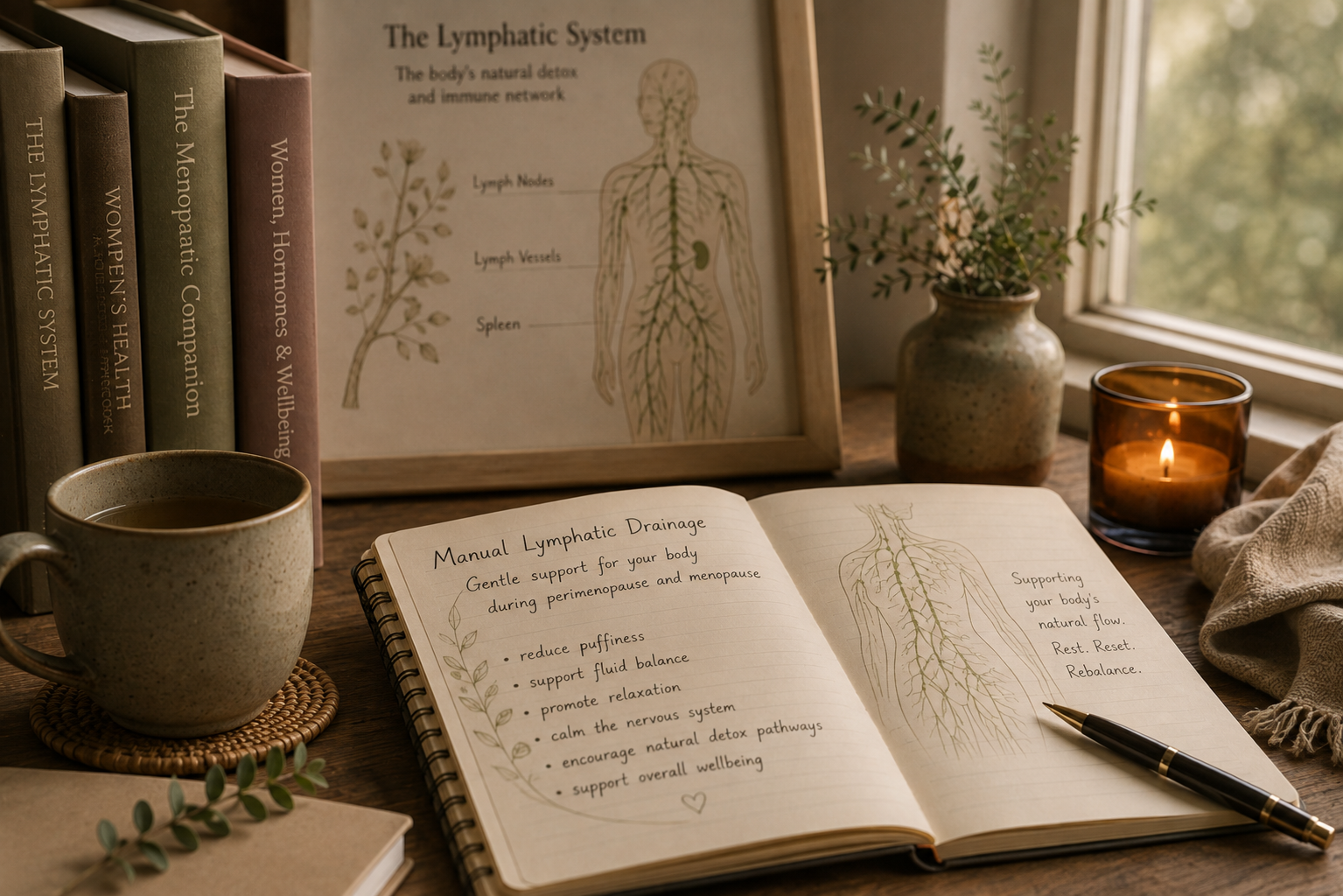
It is a network of tiny vessels, lymph nodes and organs that runs throughout the body. Its role is to collect excess fluid, proteins and cellular waste that naturally leak from our blood vessels into surrounding tissues. This fluid, known as lymph, is then filtered through lymph nodes before eventually being returned to the bloodstream.
The lymphatic system also forms an important part of the body's immune system, helping immune cells recognise and respond to bacteria, viruses and other unwanted substances.
Unlike blood circulation, however, the lymphatic system doesn't have a heart to pump it around the body. Instead, it relies on gentle muscle movement, breathing and the natural contraction of the lymph vessels themselves to keep lymph moving.
Why do some women feel puffier during perimenopause?
One of the less talked-about symptoms of perimenopause is feeling swollen or bloated.
You may notice your wedding ring becoming tighter by the afternoon, puffiness around your eyes when you wake up, or a feeling of heaviness in your legs after sitting at a desk all day.
While this isn't experienced by every woman, fluctuating hormones may play a part.
During perimenopause, oestrogen levels don't simply fall in a straight line. They can rise and fall dramatically from one week to the next. Oestrogen influences many tissues throughout the body, including our blood vessels and the way fluid moves between the bloodstream and surrounding tissues.
When hormone levels fluctuate, some women appear to retain more fluid than usual. If more fluid collects within the tissues, the lymphatic system has more work to do to return that fluid back into circulation.
Add in long hours sitting at a desk, poor sleep, stress or simply feeling too exhausted to exercise as much as you once did, and it's easy to understand why some women begin to feel heavier, puffier or more bloated than before.
What is Manual Lymphatic Drainage?
Manual Lymphatic Drainage is a specialised massage technique designed to encourage the natural movement of lymph throughout the body.
If you've never experienced it before, you might be surprised by just how gentle it feels.
Unlike traditional massage, which works into muscles to release tension, MLD uses slow, rhythmic, skin-stretching movements that follow the pathways of the lymphatic system. The treatment isn't designed to work deeply into muscles but to support the body's own natural lymphatic circulation.
Many women are surprised by how deeply relaxing they find it.
How might Manual Lymphatic Drainage help?
Many therapists who work with menopausal women believe that supporting healthy lymphatic flow may help reduce feelings of puffiness, heaviness and fluid retention.
The aim isn't to alter hormone levels or "treat menopause." Instead, the intention is to support one of the body's normal physiological systems while helping women feel more comfortable during a period of significant hormonal change.
Women who choose Manual Lymphatic Drainage commonly describe feeling:
- lighter
- less puffy
- less bloated
- more comfortable in their clothes
- deeply relaxed
- calmer both physically and mentally
- as though their body has "reset"
These are personal experiences rather than guarantees, but they are reported consistently enough that many therapists continue to recommend the treatment as part of holistic menopause support.
More than reducing swelling
Although many women initially book Manual Lymphatic Drainage because they feel swollen or bloated, it's often the sense of relaxation they remember most.
The slow, repetitive rhythm of the treatment encourages the body to move away from its "fight or flight" response and towards the parasympathetic nervous system—sometimes called our "rest and digest" state.
This is the part of our nervous system associated with slowing the heart rate, relaxing the body and supporting recovery.
For women juggling demanding jobs, family responsibilities, broken sleep and the emotional ups and downs that can accompany perimenopause, simply spending an hour allowing the body to slow down can feel restorative in itself.
Whether the greatest benefit comes from improved lymphatic flow, deep relaxation or a combination of both is still being explored. What many women tell me, however, is that they simply leave feeling calmer, lighter and more like themselves again.
What about detoxification and immunity?
You may have read that Manual Lymphatic Drainage "detoxifies the body", "boosts the immune system" or even "balances hormones."
These ideas are frequently discussed within the therapy profession, and it's easy to see why.
The lymphatic system is one of the body's natural waste-removal systems. It helps transport excess fluid, proteins and cellular waste away from tissues as part of normal physiology. Because of this, many therapists believe that supporting healthy lymphatic flow may also support these natural processes.
Similarly, because the lymphatic system plays an important role in immune function, some practitioners believe that encouraging lymphatic circulation may help support the body's natural defences.
At present, however, scientific evidence demonstrating additional detoxification or immune-boosting benefits in otherwise healthy people remains limited. Likewise, there is no evidence that Manual Lymphatic Drainage changes hormone levels or "balances hormones."
That doesn't mean women don't benefit from treatment. Rather, it reminds us that there is still much to learn about exactly how Manual Lymphatic Drainage produces the improvements that so many women report.
A gentle addition to holistic menopause care
I don't see Manual Lymphatic Drainage as a cure for menopause, nor as a replacement for medical care.
Instead, I see it as one of several gentle therapies that may help women feel more comfortable, more relaxed and better supported during a significant stage of life.
Sometimes it's about feeling less swollen. Sometimes it's about sleeping more soundly that night. Sometimes it's simply having an hour where nobody needs anything from you, and your body has permission to slow down.
Perimenopause and menopause affect every woman differently. If you've been feeling puffy, heavy, bloated or simply in need of a little time to breathe, Manual Lymphatic Drainage may be a gentle therapy worth exploring as part of your wider menopause wellbeing.