Can Holistic Therapies Help?
Most women do not come into my treatment room because they believe a massage can stop menopause.
They come because they are tired.
They may be sleeping badly, carrying tension through their shoulders or struggling to remember the last time they felt properly rested. They have often spent months coping and continuing to look after everybody else.
What they want is not another promise to “balance their hormones.”
They want to feel better.
This is where holistic therapies can have a valuable role—not by changing menopause itself, but by supporting the woman experiencing it.
What does holistic actually mean?
The word holistic is sometimes misunderstood. It does not mean rejecting medicine, and it does not mean believing that every symptom can be cured naturally.
It means looking at the person as a whole.
Poor sleep does not remain neatly inside the night. It affects energy, concentration, mood, pain tolerance and the ability to cope. Anxiety can tighten muscles and make falling asleep more difficult, while fatigue makes every other symptom feel harder to manage.
The symptoms are connected because the person experiencing them is one whole, interconnected body.
A holistic treatment begins by asking what is affecting you most today. The answer may be different from the answer you gave two weeks ago.
Why relaxation is more than a luxury
The nervous system is continually assessing what the body needs.
Under pressure, the sympathetic branch of the autonomic nervous system helps us remain alert and ready to respond. But poor sleep, persistent worry, pain and an overloaded life can leave the body spending too much time in a heightened state of arousal.
A holistic treatment cannot permanently “reset” the nervous system. What it can do is create conditions in which the body receives fewer demands: warmth, quiet, predictable touch, slower breathing and permission to stop responding for a while.
Heart rate may slow. Muscles can soften. Breathing often becomes deeper and less hurried. Many women drift into sleep.
That rest does not reverse ovarian ageing or correct a hormone level. Its value is more immediate. Physical calm can interrupt the cycle of tension, poor sleep and reduced coping—even if only temporarily.
Why touch matters
Research into massage and other touch-based interventions suggests potential benefits for short-term pain, anxiety and emotional wellbeing, although results differ between studies. Touch research is difficult to blind, and treatment cannot be separated completely from the therapist, setting or expectations.
That does not make the experience meaningless.
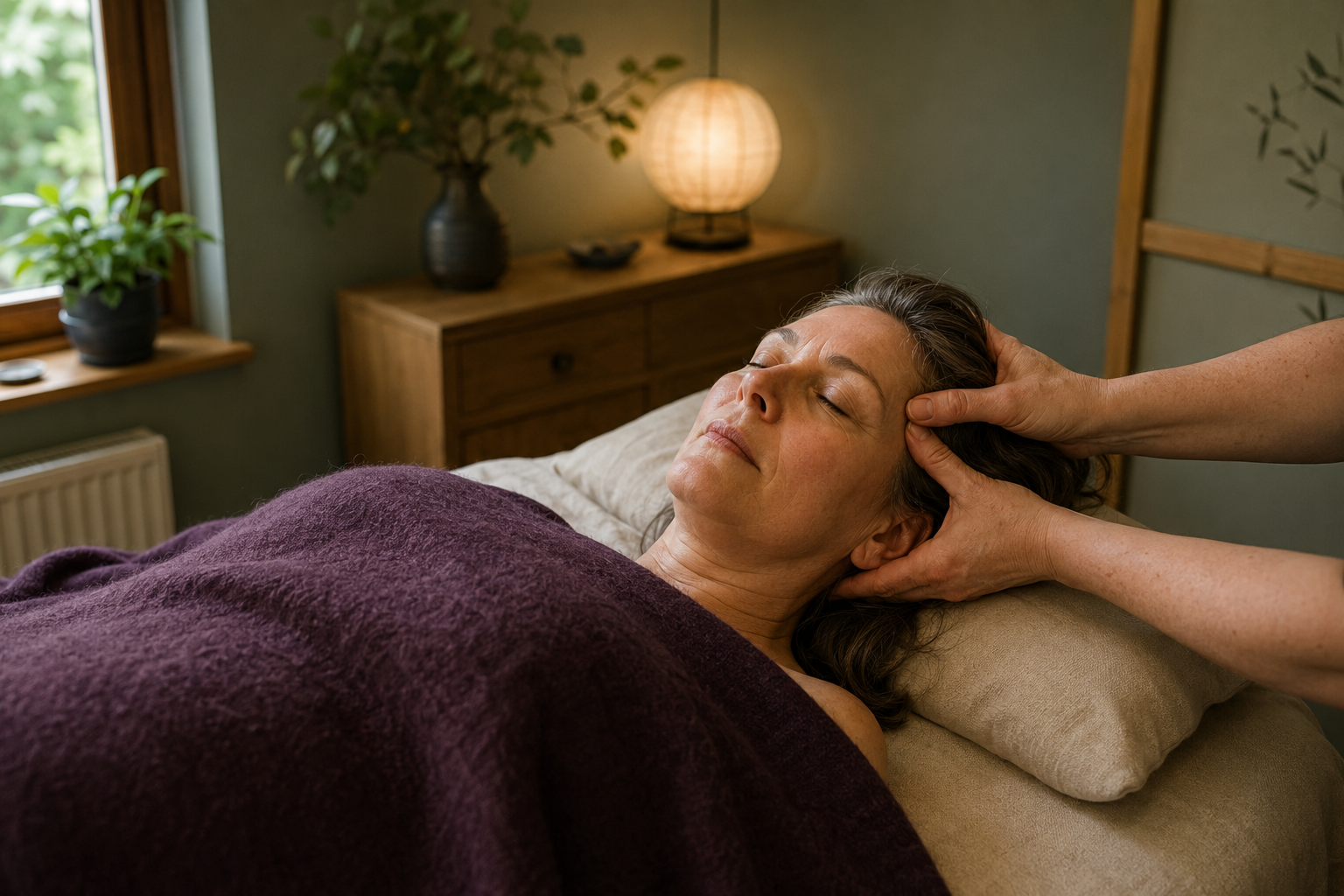
Massage can work directly with tight, uncomfortable muscles. Slow, rhythmic pressure may reveal tension a woman has been holding without noticing. Warm stones or a herbal compress can add comfort, while work around the face, scalp, neck and shoulders may help with jaw clenching or upper-body tension.
The aim is not to force the body into submission. It is to give it enough support to begin letting go.
What about reflexology?
Reflexology uses pressure on specific areas of the feet, hands or face. Traditional reflexology maps these areas to different parts of the body.
There is not strong scientific evidence that pressing a particular reflex point directly changes the ovaries, pituitary gland or hormone production. Responsible reflexology should not be presented as diagnosing illness or correcting hormone levels.
Its value may lie elsewhere.
The Association of Reflexologists describes reflexology as a complementary therapy that can promote deep relaxation and wellbeing. Some menopause studies have reported improvements in symptoms, anxiety, fatigue or quality of life, while others have found reflexology no more effective than a non-specific foot massage.
Both findings are useful. The precise map may remain scientifically uncertain, while skilled foot treatment, focused attention and deep rest may still help the woman receiving it.
How aromatherapy contributes
Aromatherapy introduces another sensory pathway: smell.
Aromatic molecules activate receptors in the nose, sending signals towards brain regions involved in emotion, memory and alertness. This helps explain why one aroma can feel comforting while another feels enlivening.
Research into essential oils for sleep and anxiety is promising in places but remains mixed, with many small studies. It is rarely possible to separate the effect of the oil from massage, expectation and the surrounding experience.
Essential oils do not balance menopause hormones. Used safely and selected for the individual, however, aroma can become part of a powerful relaxation cue—something the brain begins to associate with slowing down.
And Reiki?
Reiki is more difficult to investigate through conventional scientific methods, and research has not established the transfer of a measurable healing energy.
For many people, however, Reiki provides something rarely available in ordinary life: stillness, gentle attention and time without conversation or expectation. Whether the hands rest lightly on the body or remain just above it, the experience can feel deeply calming.
We do not have to exaggerate the explanation to respect the experience.
Why combining therapies can help
Women do not experience menopause according to a fixed treatment menu.
One woman may need slow massage around her head, face and shoulders. Another may prefer reflexology and warmth around her feet. Someone else may need gentle lymphatic work, aromatherapy or simply longer to talk before treatment begins.
This is why I prefer to combine therapies rather than expect one technique to do everything. The session can respond to the woman in front of me—not to a standard version of menopause.
Listening is part of the treatment
Many women arrive having been told that their results are normal, that their symptoms are simply their age or that nothing can be done.
Being listened to does not cure a symptom. But it can reveal a clearer pattern and help a woman decide what she needs next. That may include speaking to her GP, considering medical treatment, changing something practical or making regular space for recovery.
Holistic support works best alongside appropriate healthcare, not instead of it. A qualified therapist should understand their limits, adapt treatment to medical needs and refer a client when a symptom requires assessment.
What holistic therapy can offer
Holistic therapies cannot prevent menopause, preserve ovarian follicles or guarantee the end of hot flushes, anxiety or sleepless nights.
They can offer comfort, skilled touch, physical relaxation and a space in which nothing is being demanded of you.
That may sound modest.
But when your body has spent months braced for the next difficult night or demanding day, two hours of genuine rest is not insignificant.
Holistic therapy may not change the fact that menopause is happening.
It can help change how supported you feel while moving through it.
Further reading and professional guidance
NHS: Herbal medicines and complementary therapies
https://www.nhs.uk/tests-and-treatments/herbal-medicines-and-complementary-therapies/
Association of Reflexologists: Information for healthcare professionals
https://www.aor.org.uk/home/about-us/healthcare-professionals/
NCCIH: Massage therapy—what you need to know
https://www.nccih.nih.gov/health/massage-therapy-what-you-need-to-know
NCCIH: Aromatherapy
https://www.nccih.nih.gov/health/aromatherapy
NCCIH: Reiki
https://www.nccih.nih.gov/health/reiki
A systematic review and meta-analysis of touch interventions